





Best Flip-Flops for Plantar Fasciitis (Women)
If you live in flip-flops every summer but struggle with stabbing heel pain, you’re not alone. Plantar fasciitis is one of the most common causes of heel pain, and for women who love open footwear, it can feel like you have to choose between comfort and style. The good news: you don’t. With the right support features and strap style, flip-flops can actually help reduce strain on your plantar fascia instead of making it worse. :contentReference[oaicite:0]{index=0}
This guide walks you through what plantar fasciitis is, why “flat and floppy” sandals are a problem, and exactly what to look for in women’s flip-flops so you can stay comfortable from school runs to beach days. We’ll also talk about how different strap designs—toe-post, fabric thong, and slides—change the way your heel and arch are supported. :contentReference[oaicite:1]{index=1}
Important note: This article is for general information only and is not a substitute for medical advice. If your heel pain is severe, persistent, or worsening, please consult a podiatrist or other qualified health professional.
Understanding Plantar Fasciitis (In Everyday Language)
The plantar fascia is a thick band of connective tissue running from your heel bone to your toes. It helps support your arch and absorbs shock each time your foot hits the ground. When this tissue is overloaded or repeatedly strained, tiny tears and inflammation develop—this is plantar fasciitis. :contentReference[oaicite:2]{index=2}
Typical signs include:
- Sharp, stabbing pain in the heel with your first steps in the morning
- Pain after standing for long periods or after walking a lot
- Discomfort that flares after activity, not necessarily during it
- Feeling like your heel is bruised or very tender when pressed
Flat, unsupportive shoes make your plantar fascia work overtime. Each step forces the tissue to stretch more than it should, especially if you have high arches, low arches (flat feet), spend long hours on hard floors, or carry extra weight. That’s why the type of flip-flops you wear really matters. :contentReference[oaicite:3]{index=3}
Why Typical Flat Flip-Flops Make Pain Worse
Many inexpensive flip-flops are simply thin slabs of foam with a strap on top. They may look cute, but for plantar fasciitis, they’re a perfect storm of problems:
- No arch support: Your plantar fascia holds up your arch alone, increasing strain.
- Zero heel cushioning: Every step sends impact straight into your heel bone.
- Completely flat (no heel elevation): The fascia stays stretched with every step.
- Loose, flimsy straps: Your toes claw to keep the sandal on, adding muscle tension.
When you switch to more supportive flip-flops with better structure and smarter strap designs, you can offload that strain, reduce shock, and keep your heel pain calmer throughout the day. :contentReference[oaicite:4]{index=4}
Key Features of the Best Flip-Flops for Plantar Fasciitis (Women)
Think of a good plantar-fasciitis-friendly flip-flop as a simple orthotic sandal: it should support, cushion, and stabilize your foot without feeling heavy or rigid. Here are the most important features to look for.
1. Proper Arch Support
For plantar fasciitis, arch support is non-negotiable. Look for a footbed with a visible contour under the arch that gently lifts your midfoot instead of letting it collapse onto a flat surface. Supportive models in women’s comfort ranges often include:
- A raised midfoot area that mirrors the shape of your arch
- Firm support (not squishy) that doesn’t flatten with a thumb press
- Slightly higher arch for women with naturally high insteps
This helps the plantar fascia hold its natural shape, reducing strain every time your heel hits the ground. :contentReference[oaicite:5]{index=5}
2. Cushioned, Shock-Absorbing Footbed
Cushioning doesn’t cure plantar fasciitis, but it helps manage pain by softening impact under your heel and forefoot. The best flip-flops use soft yet resilient materials—like thicker rubber or EVA compounds—that spring back instead of flattening quickly.
When you test a sandal, notice whether:
- It feels “bouncy” rather than dead or rock-hard
- The heel area has slightly extra padding
- Your foot feels cradled rather than sitting on a thin sheet
Women’s comfort-focused flip-flops often combine this cushioning with stylish uppers, so you don’t have to sacrifice looks for comfort. :contentReference[oaicite:6]{index=6}
3. Deep, Stable Heel Cup
A deep heel cup is a small detail that makes a big difference. When the heel sits in a shallow “bowl,” it doesn’t slide side-to-side as much, and the plantar fascia is less irritated at its attachment point near the heel bone.
Ideally, you want a heel area that’s slightly sculpted rather than totally flat. Some models also offer a tiny amount of heel elevation (a mild wedge effect), which can shorten the distance the fascia has to stretch and feel more comfortable than a completely flat sole. :contentReference[oaicite:7]{index=7}
4. Slight Heel Elevation (Not Totally Flat)
Completely flat, “zero-drop” flip-flops tend to keep the fascia on full stretch. Many women with plantar fasciitis feel better in sandals with a mild heel rise—just a few millimeters higher at the heel than the ball of the foot.
This doesn’t mean wearing a high heel. It simply means choosing a sole that gently tips your foot so the fascia isn’t pulled tight with each step. :contentReference[oaicite:8]{index=8}
5. Wide, Supportive Straps
Straps are often overlooked, but they’re crucial for plantar fasciitis. The strap is what keeps your foot anchored over the supportive footbed. A good strap:
- Lies flat without digging into your skin
- Is wide enough to distribute pressure, not a thin “string”
- Holds your foot securely so you’re not gripping with your toes
Comfort-focused strap designs—whether toe-post, fabric thong, or slide—play a huge role in how stable and relaxed your foot feels while walking. :contentReference[oaicite:9]{index=9}
6. Grippy, Durable Outsole
Slipping on wet tiles or polished shopping-mall floors sends shock through your feet and can worsen heel pain. Look for outsoles with:
- Textured tread patterns for grip
- Rubber or rubber-rich compounds for traction
- Decent thickness so you’re not feeling every pebble through the sole
Strap Styles & Plantar Fasciitis: Toe-Post vs. Fabric Thong vs. Slides
The strap style you choose changes how your foot is held on the footbed. Even with good arch support, the wrong strap design for your foot shape can make you claw your toes, create friction, or feel unstable on uneven ground. :contentReference[oaicite:10]{index=10}
Toe-Post (Thong) Flip-Flops
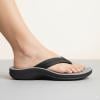
Toe-post flip-flops use a post between the big toe and second toe, with straps sweeping up onto the sides of your foot. They’re the classic beach style and work well for many women when designed correctly.
Best for plantar fasciitis when:
- The post is smooth and slightly flexible, not hard and scratchy
- The straps are broad enough to stabilize your midfoot
- You’re not feeling constant rubbing between the toes
Women with narrow or average-width feet often find that a slim yet supportive toe-post strap keeps the foot centered over a contoured, cushioned footbed—great when you want that familiar flip-flop look with serious comfort. :contentReference[oaicite:11]{index=11}
Fabric Thong Straps
Fabric or padded textile straps are a lifesaver if you have sensitive skin or get blisters easily. They trade stiffness for softness, which can be especially helpful when plantar fasciitis already makes you extra aware of every step. :contentReference[oaicite:12]{index=12}
They’re a good choice if you:
- Struggle with chafing from synthetic or plastic straps
- Need something forgiving during long walking days or travel
- Want a little bit of stretch or adjustability at the top of your foot
Pairing a fabric strap with a structured, arch-supporting footbed balances softness on the skin with firmness under the arch—ideal for long days on your feet. :contentReference[oaicite:13]{index=13}
Slide-Style Flip-Flops
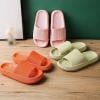
Slides use a single wide band across the forefoot or midfoot and skip the post between your toes entirely. That means zero pressure in the webbing between your toes—great if you hate toe-posts or already have irritation there. :contentReference[oaicite:14]{index=14}
Slides work best for plantar fasciitis when:
- The strap is snug (not floppy) so your foot doesn’t slide off the back
- The footbed has good arch support and a heel cup
- You’re mostly wearing them for casual walking, errands, or travel—not running
Many women love slides with contoured, comfort-oriented footbeds because they combine support with a modern, street-wear-friendly look that pairs well with dresses, jeans, and loungewear. :contentReference[oaicite:15]{index=15}
Matching Your Foot Type & Lifestyle to the Right Flip-Flops
Narrow vs. Wide Feet
If you have narrow feet:
- Look for slimmer toe-post straps that sit closer to the sides of your foot
- Avoid overly wide slides unless the strap is adjustable (buckle or Velcro)
- Make sure your foot stays centered and doesn’t drift sideways on the footbed
If you have wide feet or bunions:
- Choose broader straps that don’t cut into the sides of your foot
- Consider soft fabric straps that better adapt to foot shape
- Check that your toes and heel stay fully on the footbed with no overhang
Supportive women’s flip-flops are often designed with slightly roomier footbeds and flexible uppers to accommodate a variety of widths, which is helpful when you’re managing plantar fasciitis and can’t tolerate tight, restrictive footwear. :contentReference[oaicite:16]{index=16}
Arch Type: Low, Neutral, or High
Your arch type affects what kind of support feels best. While only a professional assessment can be precise, a simple home check can still guide your flip-flop choices.
- Low arches / flat feet: Look for firmer, structured support that prevents your arch from collapsing.
- Neutral arches: Moderate support with cushioning usually feels best.
- High arches: You may prefer slightly higher arch contours and extra cushioning under the ball and heel.
Many plantar-fasciitis-friendly sandals come labeled as “supportive,” “comfort,” or “orthopedic-inspired.” These are good starting points when shopping, especially if you combine them with the strap and fit tips above. :contentReference[oaicite:17]{index=17}
By Activity & Lifestyle
1. Everyday Errands & Around Town
For grocery runs, school drop-offs, and city walking, choose flip-flops with:
- Reliable arch support and heel cup
- Secure toe-post or snug slide strap
- A sole thick enough to absorb shock on concrete
Many women appreciate comfort-focused styles that blend padded footbeds with chic straps, so your “support sandal” still looks polished with jeans or casual dresses. :contentReference[oaicite:18]{index=18}
2. Beach & Pool Days
At the beach or pool, you’ll want water-friendly materials as well as support:
- Rubber or EVA footbeds that don’t soak up water
- Straps that stay secure when wet
- Textured outsole for grip on slippery tiles or wet decking
Supportive water-ready flip-flops can give you the cushioning your heels need without being ruined by sand and salt. :contentReference[oaicite:19]{index=19}
3. Travel & All-Day Walking
For vacations, sightseeing, or long airport days, prioritize:
- Strong arch support and resilient cushioning that won’t “bottom out” by noon
- Soft, non-irritating straps for long wear
- A more secure fit—this can mean toe-post designs with broader straps or supportive slides
Supportive comfort flip-flops paired with lightweight sneakers can give you options: sandals for relaxed segments, closed shoes for more intense walking. :contentReference[oaicite:20]{index=20}
How to Check Fit at Home (Plantar Fasciitis Edition)
Once your new flip-flops arrive, a quick at-home test can tell you if they’ll truly help your heel pain:
- Check the arch: Stand normally. Do you feel gentle support under the arch, or is it completely flat?
- Walk 15–20 steps: Is your heel pain stable, slightly better, or instantly worse?
- Look at your posture: Do your knees cave inward (overpronation) or roll outward excessively?
- Inspect your foot position: Are your toes and heels fully on the footbed with no overhang?
- Assess strap comfort: No red marks, pinching, or need to grip the sole with your toes.
- Re-check after 30 minutes: Your feet should feel at least as good—if not better—than in flat sandals.
If your pain spikes, or you find yourself clawing with your toes to keep the sandals on, they’re not a good match—no matter how cute they are. :contentReference[oaicite:21]{index=21}
Common Mistakes Women Make When Buying Flip-Flops for Plantar Fasciitis
- Choosing purely by looks: Thin, flat fashion flip-flops are rarely supportive enough for heel pain.
- Assuming “soft = supportive”: Ultra-squishy soles feel comfy at first but may lack structure.
- Ignoring strap fit: Loose straps cause sliding; tight straps cause friction and clawing.
- Wearing completely flat soles all day: Zero-drop sandals can over-stretch the fascia.
- Keeping worn-out pairs too long: Once the arch support flattens, your plantar fascia gets less help.
Quick Comparison: What to Prioritize
| Feature | Why It Matters for Plantar Fasciitis | What to Look For |
|---|---|---|
| Arch Support | Reduces strain on the plantar fascia | Visible contour, firm midfoot support |
| Heel Cup | Stabilizes heel and reduces irritation | Shallow “bowl” around the heel, not flat |
| Cushioning | Softens heel impact | Thicker, springy sole that doesn’t flatten quickly |
| Heel Elevation | Prevents excessive fascia stretch | Slight heel rise, not completely flat |
| Strap Style | Controls stability and toe gripping | Wide, smooth straps; secure fit with minimal rubbing |
| Outsole Grip | Reduces slips and sudden jolts | Textured rubber or similar with visible tread |
Caring for Your Supportive Flip-Flops
Even the best plantar-fasciitis-friendly flip-flops won’t last forever, but good care extends their life and keeps support levels consistent. :contentReference[oaicite:22]{index=22}
- Rinse off sand, pool chemicals, and saltwater after use.
- Let them dry in the shade—avoid direct high heat or leaving them in a hot car.
- Clean straps regularly so they stay soft and comfortable against your skin.
- Replace pairs once you can see deep impressions in the footbed or feel arch support weakening.
When to See a Professional
Supportive flip-flops can make a huge difference for everyday comfort, but they’re just one part of managing plantar fasciitis. See a podiatrist or other qualified professional if:
- Your heel pain lasts more than a few weeks despite supportive footwear.
- You have pain in both heels or pain that wakes you up at night.
- You notice numbness, tingling, or significant swelling.
- Walking becomes difficult or your gait changes dramatically.
Final Thoughts: Finding the Best Flip-Flops for Plantar Fasciitis (Women)
You don’t have to give up flip-flops to protect your plantar fascia. By prioritizing arch support, cushioning, a stable heel cup, slight heel elevation, and secure straps, you can enjoy lightweight, airy footwear that respects your feet instead of punishing them.
Start by choosing comfort-focused women’s flip-flops designed with foot health in mind, then fine-tune your choice using strap style, foot width, and activity level. With the right pair, every step—from the kitchen to the boardwalk—can feel more supported, more stable, and a lot more enjoyable, even with plantar fasciitis.